This blog has been updated with fresh new tips and insights.
Thank you so much for taking a journey through our unique discovery process and learning about our dedicated Launch Sequence offering, over the last few blogs. First, we talked about What Discovery is and why we do it, and then we discussed how we actually go about the Discovery process.
Today’s third installment is about how we apply the findings from the process into actionable solutions for our clients. We synthesize our findings and start to build upon the main points of emphasis. This leads us to tangible ideas for client feedback, refining and iterating on those ideas during pre-production, and finally to executing the concepts - thus creating the experience… TA DA!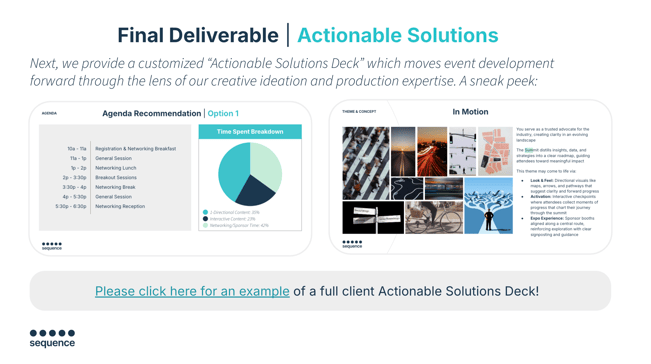
What’s Next?
So, after undertaking the initial discovery process and having our clients corroborate our findings, we move on to the solutions and ideation phase. This part challenges us to balance blue sky thinking and working within logical parameters. We build actively upon the strategic foundation to begin planning for experience takeoff. It’s like writing on lined paper; structured, but anything is still possible.
Of course in addition to what the client has defined during discovery, other realities have to be kept in mind as well. We’re on earth (as of yet - virtual experiences notwithstanding!) so there is gravity, we have a budget, venues have rules & regulations, there are set rigging points (or sometimes there are no rigging points at all!), we have a finite load-in and load-out window, etc. Even so, we always want to think BIG and bold to start.
Who?
Having the right people at the table on our side is key here too! Ideation is typically also led by the strategy arm of the SEQ Creative team, but our Production team is always key here too. Everyone joining this part of the process on our side should have been present for discovery or fully briefed on all aspects to make this as productive and targeted in strategy. We want the process of ideating and developing solutions to benefit from everyone’s unique points of view, but also to work within the same set of information.
How?
We always start internally with a live brainstorming meeting and a clear agenda. Any existing ideas or must-haves can be addressed initially in our shared notes or internal preparation communication. We like to allow as much time for this conversation as needed, typically starting with a 2-hour window so it’s not rushed. Additional time can be added as needed.
This is less about yaying or naying any ideas in real time, but seeing what resonates with the group and allowing us to riff off of each other organically and assess what else we may need to research or uncover. The germ of an incredible idea can come from anywhere (sometimes the best ideas come from our interns or cultural trends - we’re open to all!) but where it goes and how it develops during this meeting can be pure magic.
Presenting Ideas
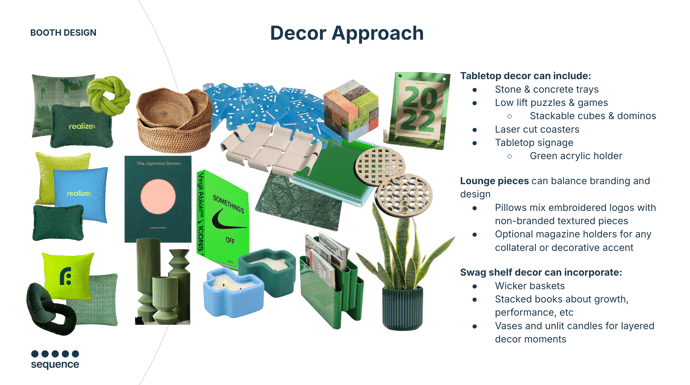
Coming out of these meetings, we see what’s floated to the top and start to formalize those ideas for client feedback. We have to give each idea or approach a shape and make it tangible for the client to understand it. We have found it’s best to put just the right amount of information in front of the client to get their imagination jumpstarted.
To cap off the Launch Sequence process, all of these elements are presented as the Actionable Solutions Deck deliverable. This can be taken by our client for their own development, or we segue this deck into our full event production process into our Event Deck. We typically present 3 versions of this comprehensive visual rundown of the event during event production. Round 1 is what we call the “Spaghetti phase” where ideas are still loose, but clearly explainable. Imagery in round 1 is inspirational, not yet literal. Any specifics are presented, where able. We want to assess if the client connects to the idea and is interested to learn more in round 2.
Assessing & Incorporating Feedback
We always aim to review round 1 of the Event Deck live with clients to ensure that all information is conveyed accurately, and any questions answered in real time so that the ideas all land as intended. Typically clients will need some time to absorb this before giving their detailed feedback. We’ll reiterate, it’s imperative than anyone being asked to give feedback on the Event Deck and who has the authority to yay or nay has been involved with the discovery process. We bolded it again for emphasis ;)
Once we have the client’s feedback, we take the next steps to update, streamline, put some ideas to the side, and potentially ideate some more.
Ideation Continues… While the Production Phase Begins (Aka, the Baton Relay)
As you can imagine, the following is a dramatically simplified rundown of the remaining event design and production process as it pertains specifically to Launch Sequence and beyond. We couldn’t possibly encompass everything that happens within a single blog! Sometimes this road is days long, weeks long, months long… but we want you to see how we take our findings from discovery all the way through to the final experience.
We finalize event thematics, start to mock-up what things will look like, and firm up how they will be executed. We start to speak to the other vital details: decor, asset needs, guest experience and flow and all other elements creating a full and cohesive experience. And of course, we need to provide more pricing information so clients can make informed decisions about what to keep and what to cut before round 3 of the Event Deck (typically, the final round).
Before and after each round, we ask ourselves these questions (and many more!):
Do these ideas, concepts or other elements point back to the goals / priorities / early call-outs from Launch Sequence or discovery?
Has the client’s feedback been taken into consideration?
Have we assessed the impact on the guest experience?
Are we measuring what we need to measure in terms of success and results?
Has anything changed fundamentally that we need to factor in?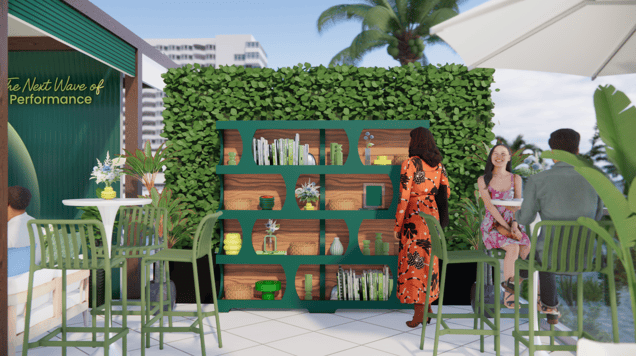
Production, in a Nutshell
And then… (major oversimplification alert!) We present the round 3 of the Event Deck which is essentially the entire final experience on paper. Then, we do ALL.THE.THINGS. We dot the i’s and cross the t’s. The experience happens - we execute, we observe, we adjust.
And when it’s all said and done, we revisit the journey and check in with ourselves and the client. How’d we do?! Did we deliver a creative solution which embodied the client’s definition of success? Did the end result reflect what we learned and agreed upon upfront? And the most important question - how can we do it even better next time?!
Thank you so much for joining us on our SEQ discovery journey! It’s been amazing sharing such an important part about what we do in more detail. We would love to work with you to create a perfectly strategic and creative experience for your brand or organization, so drop us a note and we can get started on your Launch Sequence experience!